
Written by Bandit Distro Editorial Team ·
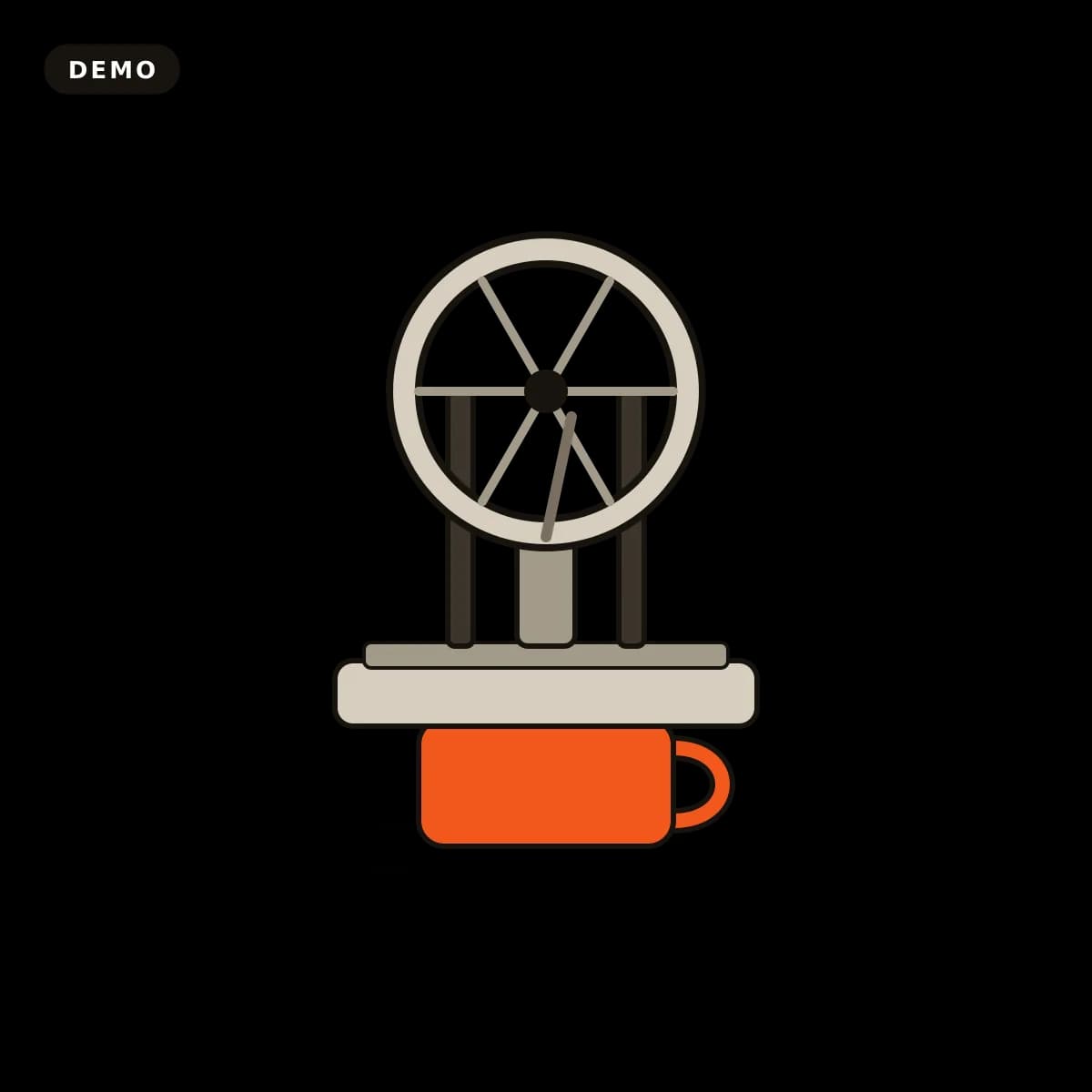
A low temperature Stirling engine is the desk toy that sits on a mug of hot coffee and spins its flywheel with no battery, no fuel and no exhaust. It is a real heat engine, running the cycle a Scottish minister patented in 1816. Once you see what the foam disc inside is doing, the rest is easy to follow, and so is the reason an engine refuses to start.
The short answer
The engine holds a fixed amount of air between a warm plate and a cool plate. A loose foam disc called the displacer shuttles that air back and forth, so it is heated, then cooled, then heated again. Warm air pushes harder than cool air, and a small piston turns that changing pressure into motion. Wikipedia's Stirling engine entry calls the type a "closed-cycle regenerative heat engine, with a permanent gaseous working fluid": the same gas stays sealed inside and is never burned or vented.
On a coffee cup Stirling engine the cup is the warm side and the room is the cool side. Colorado State University's physics demonstration notes describe their unit as unpressurized, running near atmospheric pressure, and producing less than one watt.
What is a displacer in a Stirling engine?
The displacer is the wide, light disc inside the chamber. Its job is to decide where the air is. When the displacer sits high, most of the air is down against the warm plate. When it drops, the air slips around it to the cool plate above.
The second moving part is the power piston, the small cylinder near the flywheel. NASA's page on dynamic radioisotope power, about Stirling machines for spacecraft, puts the division of labor in one line: "The gas is moved by the displacer and the gas acts upon the power piston."
Both parts hang off the same shaft, a quarter turn apart. The University of California, Santa Barbara's lecture demonstration write-up says "the crank arms for the displacer and the piston are 90 degrees out of phase." The whole cycle depends on that offset.
The cycle, one turn of the flywheel
Start with the engine on a mug of hot water: bottom plate warm, top plate at room temperature.
- Heating. The displacer is high, so the air sits against the warm bottom plate. It heats up and its pressure rises.
- Expansion. The higher pressure pushes the power piston outward. This is the power stroke, and it turns the flywheel.
- Cooling. A quarter turn later the linkage drops the displacer. The air moves to the cool top plate, gives up heat, and its pressure falls.
- Compression. The piston moves back in, squeezing the cooled air. Then the displacer rises and the air returns to the warm plate.
UC Santa Cruz's Low Temperature Stirling Engine demo page gives the textbook names: isothermal expansion, constant-volume heat removal, isothermal compression and constant-volume heat addition. The engine comes out ahead because squeezing cool air costs less work than warm air gives back when it expands.
Why the flywheel needs a push
The compression step makes no power. John S. Reid, a physicist at the University of Aberdeen, writes in his paper Stirling Stuff that compression "uses up some but not all of the work generated by the expansion and in practice is driven by the flywheel." Purdue University's Low Delta-T Stirling Engine page adds that energy stored in the flywheel is also what moves the displacer.
At rest there is nothing stored. The displacer is still, so no air is being swapped between the plates and the pressure never changes. Someone has to supply the first turn. UC Santa Cruz's procedure is to wait 15 seconds after setting the engine on the cup and then spin the flywheel. Purdue asks for a gentle spin.
The Carnot limit, worked out
Physics sets a ceiling on how much heat any engine can turn into work. OpenStax's College Physics states it in the section on Carnot's perfect heat engine: maximum efficiency is 1 minus Tc/Th, where the cold and hot temperatures "are in kelvins (or any other absolute temperature scale)."
Take water at 90 C under a 20 C room:
- Hot side: 90 + 273.15 = 363.15 K
- Cold side: 20 + 273.15 = 293.15 K
- 293.15 / 363.15 = 0.807
- 1 - 0.807 = 0.193, or about 19 percent
That 19 percent is the theoretical ceiling for a perfect engine between those temperatures. A desk toy gets nowhere near it. The OpenStax section says "no real heat engine can do as well as the Carnot efficiency," and Reid notes that real Stirling engines "usually can't manage half the efficiency of the ideal engine." He cites a measurement of a similar tabletop model that put its output at 3.4 milliwatts. The ceiling also sinks as the cup cools.
How long does a Stirling engine run on hot water?
Until the plates are too close in temperature for the pressure swing to beat friction. That depends on the engine, the cup and the room, so there is no single number. Two reference points: Reid writes that his own model "runs for well over an hour" on a mug of hot water, tea or coffee, and Purdue says its demo engine needs at least 4 C between the plates. Both figures describe those particular engines.
Does ice make a Stirling engine run faster?
Ice alone will run one. Reid describes setting his model on a table with an ice cube in a plastic bag on the top plate, and Colorado State lists room temperature against an ice cube as a workable pair.
Whether it runs faster is arithmetic, and this paragraph is reasoning from the Carnot formula, not a measured result. Room air at 20 C against ice at 0 C is a 20 degree gap, with a ceiling near 7 percent (1 - 273.15/293.15). That is a smaller gap than hot coffee gives, so expect a slower engine. Hot water below and ice above makes a 90 degree gap and a ceiling near 25 percent. Check your engine's instructions before putting anything wet on it. Colorado State's notes say not to let water pool on the device.
Why won't my Stirling engine start?
This checklist is reasoning from the physics above. Each line says what is cited and what is inferred. The instructions that came with your engine take priority, including how hot the water may be.
- Not enough temperature difference. Purdue's unit needs at least 4 C between its plates (cited). Lukewarm coffee or a warm room narrows the gap (inferred).
- Not enough time. Colorado State's tip is to be patient, because the engine takes a minute to warm up and start (cited). After a long run the top plate warms as well and the gap closes (inferred). Let it cool.
- Wrong spin direction. UCSB reports that its engine turns counterclockwise on a beaker of hot water and clockwise on a cold pack, seen from the propeller side (cited). So direction depends on which plate is warm. If the flywheel stops soon after your push, try the other way (inferred).
- Friction. With less than a watt available (cited to Colorado State), a little drag can stall it (inferred). Look for dust on the shaft, a bent linkage or a displacer rubbing the wall. Whether to clean or oil anything is a question for the maker's instructions.
- An air leak. The cycle needs a fixed amount of air to squeeze and release, so a chamber that no longer seals loses its pressure swing. This one is inference only.
Stirling engine vs steam engine
A steam engine boils water and vents the steam after each stroke. A Stirling engine reuses the same sealed gas. Reid lists the advantages the original design had over steam, among them "no valves, no cylinder exhaust, quieter running, no need for a plentiful supply of water" and no boiler to explode. Steam won the 19th century anyway: his abstract says the Stirling design "was eclipsed by the steam engine and, later, the internal combustion engine."
Who invented the Stirling engine?
Robert Stirling, a farmer's son born in 1790 in rural Perthshire, who was ordained as a Church of Scotland minister in 1816. Late that year he applied for patent No. 4081 for what he called an "Economiser," according to Reid's account. The economiser was a heat exchanger that takes heat from the gas on its way to the cold side and hands it back on the return trip, and the patent described an engine built around it. Robert and his brother James filed an improved design in 1827. He died at 88.
Choosing one
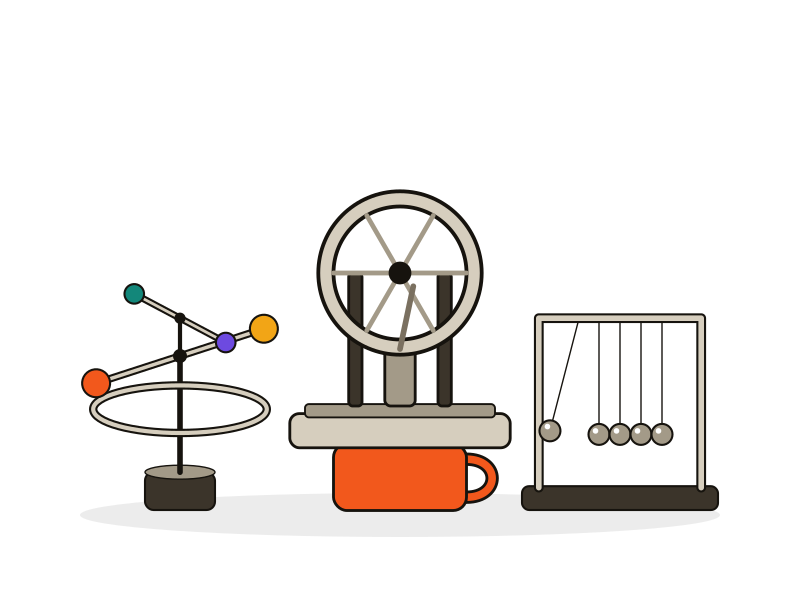
Our Stirling engine model sits with the kinetic desk sculpture and the Newton's cradle in the same niche. For a gift or a classroom, the question that matters is which heat source the engine is built for. A flat-plate engine like the one described here runs on a cup of hot water. Flame-heated models use the same cycle with a much hotter source. Both kinds are in the Stirling engines department, with the rest of desk toys and science, and new arrivals show up in The Haul.
 Demo
Low-temperature engine model that runs on the heat from a warm mug
Demo Stirling Engine Model
SKU DEMO-SCI-001